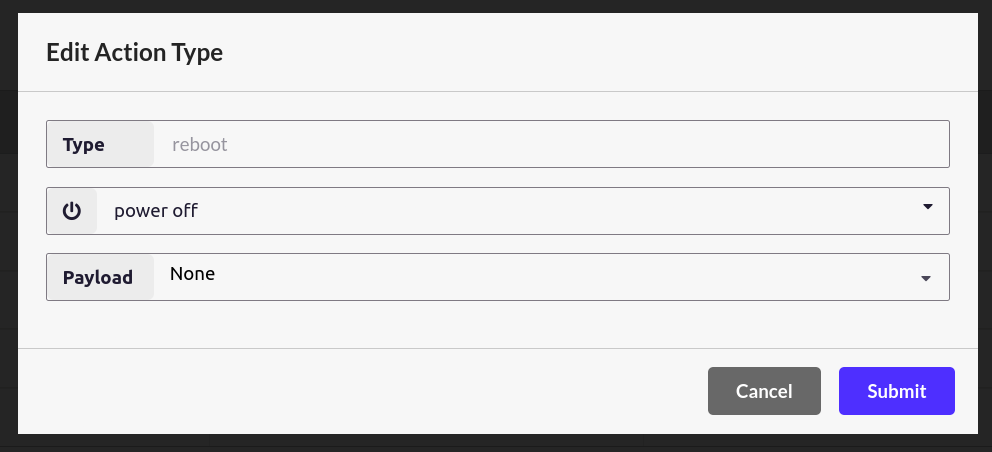
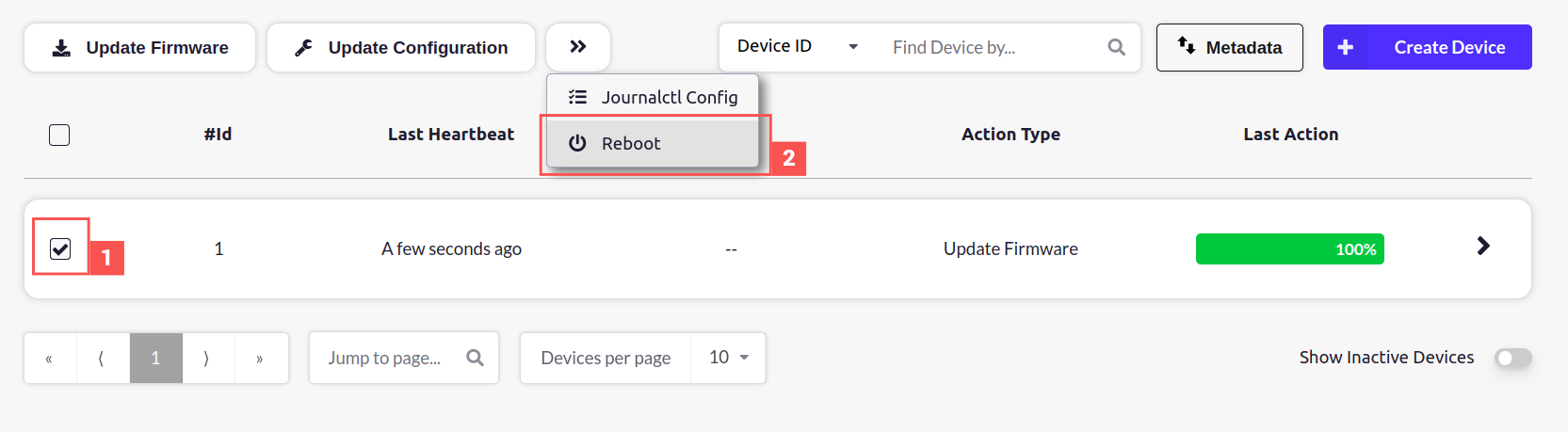
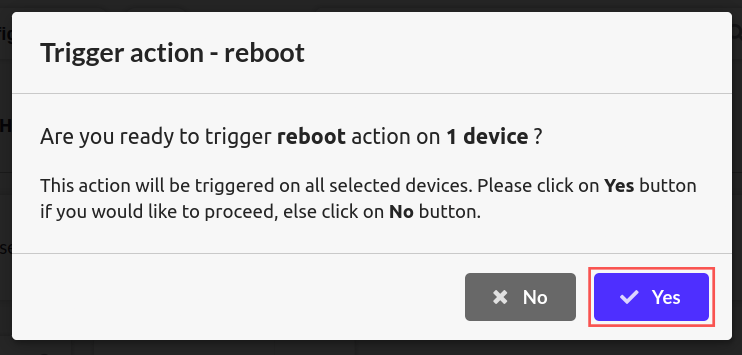
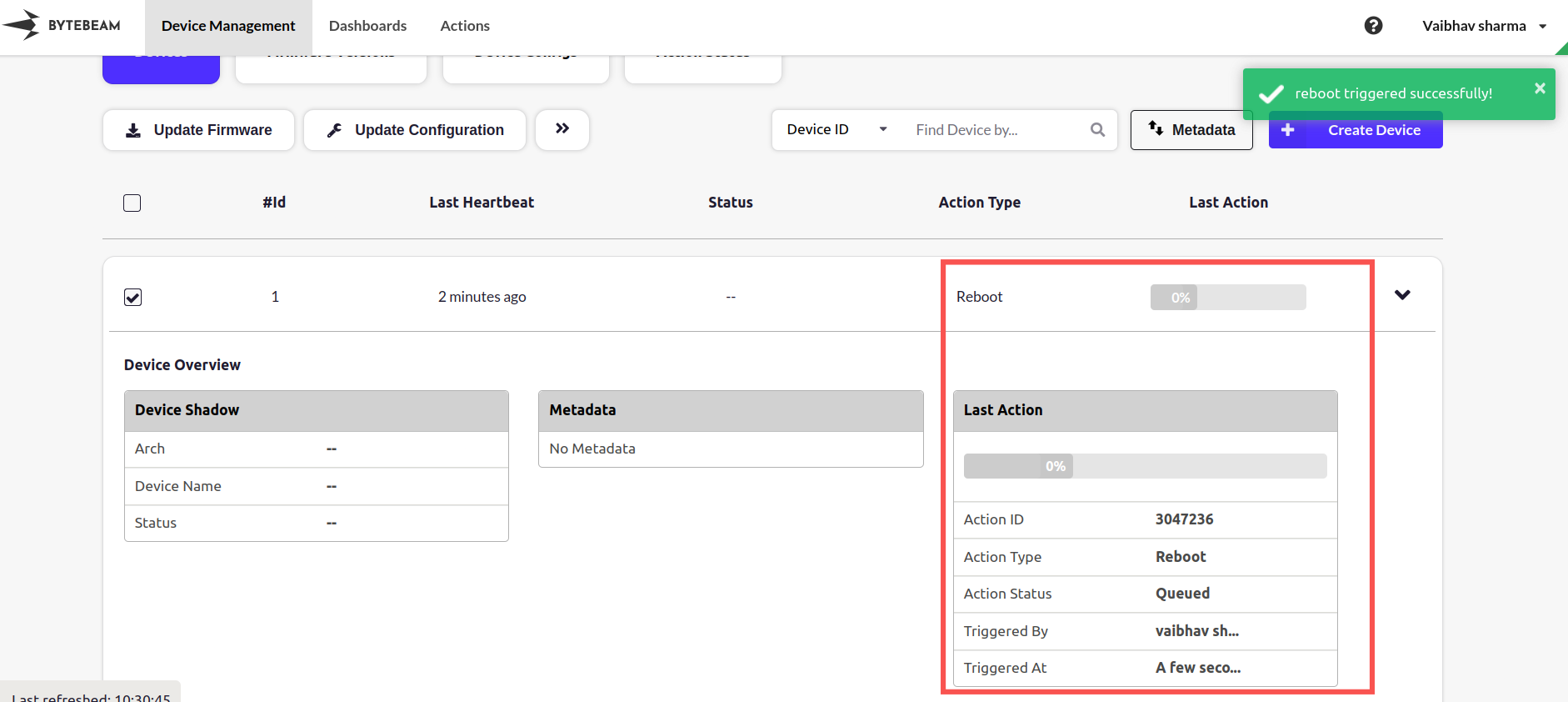
config.toml. If you have followed the guide this file will be present in /usr/local/share/bytebeam folder.
Edit this file to add the line actions=[] under [tcpapps.1] section.


Documentation Index
Fetch the complete documentation index at: /llms.txt
Use this file to discover all available pages before exploring further.
Learn how to effectively use the actions feature of Bytebeam cloud on your Linux device with this comprehensive guide. Discover step-by-step instructions on creating a “reboot” action and gaining control over the uplink through essential commands.
config.toml. If you have followed the guide this file will be present in /usr/local/share/bytebeam folder.
Edit this file to add the line actions=[] under [tcpapps.1] section.
persistence_path = "/data/local/tmp/uplink/persistence"
action_redirections={update_firmware="install_firmware"}
[tcpapps.1]
port=5050
actions=[{name="reboot"}]
[downloader]
path="/data/local/tmp/uplink/downloads"
actions=[{name="update_firmware", timeout=610}, {name="send_file"}]
[apis]
enabled=true
port=3333
[ota_installer]
path="/data/local/tmp/uplink/ota"
actions=[{name="install_firmware", timeout=610}]
uplink_port=5050
[logging]
tags=["sshd", "systemd"]
stream_size=1
min_level=7


import socket
import json
import time
import os
import threading
s = socket.socket(socket.AF_INET, socket.SOCK_STREAM)
s.connect(("localhost", 5050))
# Converts JSON data received over TCP into a python dictionary
def receive_action(s):
return json.loads(s.recv(2048))
# Constructs a payload and sends it over TCP to uplink
def send_data(s, payload):
send = json.dumps(payload) + "\n"
s.sendall(bytes(send, encoding="utf-8"))
# Constructs a JSON `action_status` as a response to received action on completion
def action_complete(id):
return {
"stream": "action_status",
"sequence": 0,
"timestamp": int(time.time() * 1000000),
"action_id": id,
"state": "Completed",
"progress": 100,
"errors": [],
}
# Reboots the device
def reboot(action):
payload = json.loads(action["payload"])
print(payload)
resp = action_complete(action["action_id"])
print(resp)
send_data(s, resp)
os.system("sudo reboot")
def receive_actions():
while True:
action = receive_action(s)
print(action)
if action["name"] == "reboot":
print("reboot action received")
reboot(action)
print("Starting Uplink Bridge App")
threading.Thread(target=receive_actions).start()
const net = require("net");
const client = new net.Socket();
client.connect(5050, "localhost", () => {
console.log("Connected to server");
});
// Converts JSON data received over TCP into a JavaScript object
function receiveAction() {
return new Promise((resolve, reject) => {
client.once("data", (data) => {
try {
resolve(JSON.parse(data));
} catch (e) {
reject(e);
}
});
});
}
// Constructs a payload and sends it over TCP to uplink
function sendData(payload) {
const send = JSON.stringify(payload) + "\n";
client.write(send, "utf-8");
}
// Constructs a JSON `action_status` as a response to received action on completion
function actionComplete(id) {
return {
stream: "action_status",
sequence: 0,
timestamp: Date.now() * 1000,
action_id: id,
state: "Completed",
progress: 100,
errors: [],
};
}
// Reboots the device
function reboot(action) {
const payload = JSON.parse(action.payload);
console.log(payload);
const resp = actionComplete(action.action_id);
console.log(resp);
sendData(resp);
exec("sudo reboot", (error, stdout, stderr) => {
if (error) {
console.error(`exec error: ${error}`);
return;
}
console.log(`stdout: ${stdout}`);
console.error(`stderr: ${stderr}`);
});
}
async function receiveActions() {
while (true) {
const action = await receiveAction();
console.log(action);
if (action.name === "reboot") {
console.log("reboot action received");
reboot(action);
}
}
}
console.log("Starting Uplink Bridge App");
receiveActions();
use serde_json::{json, Value};
use std::io::{Read, Write};
use std::net::TcpStream;
use std::process::Command;
use std::{thread, time};
fn main() {
let mut stream = TcpStream::connect("localhost:5050").expect("Could not connect to server");
// Start a thread to receive actions
let mut stream_clone = stream.try_clone().expect("Failed to clone stream");
thread::spawn(move || {
receive_actions(&mut stream_clone);
});
}
fn receive_action(stream: &mut TcpStream) -> Value {
let mut buffer = [0; 2048];
stream
.read(&mut buffer)
.expect("Failed to read from stream");
serde_json::from_slice(&buffer).expect("Failed to parse JSON")
}
fn send_data(stream: &mut TcpStream, payload: Value) {
let send = payload.to_string() + "\n";
stream
.write_all(send.as_bytes())
.expect("Failed to write to stream");
}
fn action_complete(id: i64) -> Value {
json!({
"stream": "action_status",
"sequence": 0,
"timestamp": time::SystemTime::now()
.duration_since(time::UNIX_EPOCH)
.expect("Time went backwards")
.as_micros() as i64,
"action_id": id,
"state": "Completed",
"progress": 100,
"errors": []
})
}
fn reboot(action: &Value) {
let payload = &action["payload"];
println!("{:?}", payload);
let resp = action_complete(action["action_id"].as_i64().unwrap());
println!("{:?}", resp);
send_data(&mut stream, resp);
Command::new("sudo")
.arg("reboot")
.output()
.expect("failed to execute process");
}
fn receive_actions(stream: &mut TcpStream) {
loop {
let action = receive_action(stream);
println!("{:?}", action);
if action["name"] == "reboot" {
println!("reboot action received");
reboot(&action);
}
}
}
package main
import (
"encoding/json"
"fmt"
"net"
"os"
"os/exec"
"strconv"
"time"
)
func main() {
conn, err := net.Dial("tcp", "localhost:5050")
if err != nil {
fmt.Println("Error connecting:", err.Error())
os.Exit(1)
}
// Start a goroutine for receiving actions
go receiveActions(conn)
fmt.Println("Starting Uplink Bridge App")
}
// receiveAction reads and decodes JSON data from the connection
func receiveAction(conn net.Conn) map[string]interface{} {
buffer := make([]byte, 2048)
length, _ := conn.Read(buffer)
var data map[string]interface{}
json.Unmarshal(buffer[:length], &data)
return data
}
// sendData encodes the payload to JSON and sends it over the connection
func sendData(conn net.Conn, payload map[string]interface{}) {
send, _ := json.Marshal(payload)
conn.Write(append(send, '\n'))
}
// actionComplete constructs a JSON action_status response
func actionComplete(id interface{}) map[string]interface{} {
return map[string]interface{}{
"stream": "action_status",
"sequence": 0,
"timestamp": time.Now().UnixNano() / int64(time.Microsecond),
"action_id": id,
"state": "Completed",
"progress": 100,
"errors": []string{},
}
}
// reboot performs a system reboot
func reboot(action map[string]interface{}) {
payload := action["payload"].(map[string]interface{})
fmt.Println(payload)
resp := actionComplete(action["action_id"])
fmt.Println(resp)
sendData(conn, resp)
cmd := exec.Command("sudo", "reboot")
cmd.Run()
}
// receiveActions listens for actions and processes them
func receiveActions(conn net.Conn) {
for {
action := receiveAction(conn)
fmt.Println(action)
if action["name"] == "reboot" {
fmt.Println("reboot action received")
reboot(action)
}
}
}